
One of the most common themes I encounter as a parent carer and as an advocate for other parents and disabled people is a profound social and emotional isolation. Our lives are just different or chaotic enough to preclude the chats at the school gate, visits to the park or gentle walks to the shops in which small words and conspiratorial glands lead to play dates and friendships both between children and parents.
Instead, we find ourselves apart, “othered” by our circumstances. Our children all too often struggle to make or maintain friendships and we retreat from a world that seems to find us “too much”… or simply misunderstands and maybe fears us.
In response to this experience, I have become hyper-vigilant and hyper-aware of any opportunity for connection. I am primed to notice any potential path to friendship. As a result, I experience serendipity on an unusually frequent basis.
Serendipity: the occurrence and development of events by chance in a happy or beneficial way
In reality, serendipity is closely associated with its human element – one must be open to such happy discoveries in order to notice them even when one is not looking for them!
Much of my work relies on an expectation that there will be support somewhere, that there are always “next steps” in the face of hardship, suffering and despair. And sometimes, those next steps are very tiny and unexpected. Many of the families I work with have almost unknowingly found their solutions before I meet them, but not recognised the remarkable work they are doing. So initially, I take the time to help them see the love and dedication they have and are showing for their children: the research into their children’s “conditions”; the time taken to consider previously unconsidered parenting styles or “therapies”; extra-curricular activities, tutors, clubs that they never realised existed.
In turn, I share the knowledge I have garnered over more than twenty years. That might be in the form of tiniest tips to support a child in meltdown, or formal work to ensure public services are doing as they should. It could be finding the elusive “self-care” that we all speak of so highly but struggle to implement. And often, it’s about signposting a family to resources that are only catalogued in our collective mind – the community knowledge that is so difficult to create these days (no, the “local offer” websites do not solve this problem – a discussion for another day!).
Through all of this, the connection I forge with these families is all the stronger when it is dynamic. By learning from them, I empower them with the realisation that they can do far more than they believe themselves able. And in that relationship, my hope is always that they feel able to continue their journey without me – when the time is right for each.
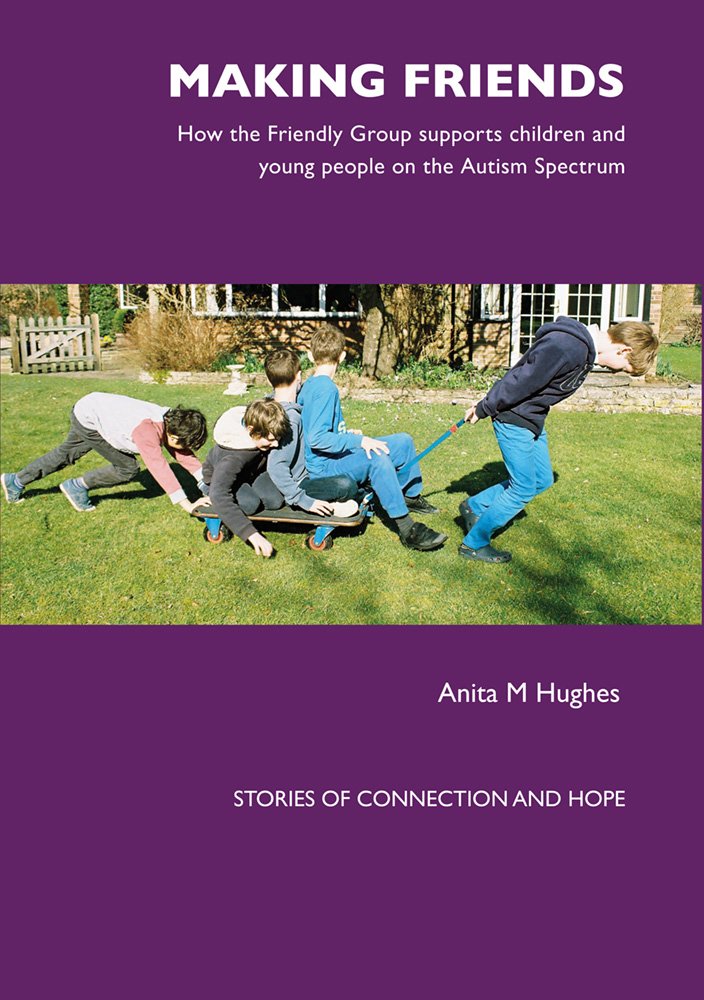
One of these encounters has led me to the astonishingly beautiful and moving work of Anita Hughes, whose book “Making Friends” I have just devoured on a sunny May Saturday.
Anita (her style and manner draw me to use her first name – I think of her as a friend I have yet, and hope one day, to meet) is an educational psychologist who has developed a social and therapeutic group “intervention” (oh my, how I hate that word, but it seems the closest fit for now) called “the friendly group”.
Thrilled and delighted at the notion of a therapeutic approach to friendship and social interaction for autistic children (well.. children who struggle with friendship), I ordered Anita’s book that very day. It arrived last week and has sat patiently on my desk awaiting the weekend and a few precious “free” hours.
I admit that initially I was a little daunted. I work hard, my home life continues to be quite intense demand significant emotional energy and I try to find time for creative pursuits that replenish me. So any additional moments are precious opportunities for rest and “escape”. Reading a non-fiction book that sits squarely in my world of work felt a little more like “homework” than “pleasure”.
Oh my goodness was I wrong!
Love, compassion, understanding and an uncompromising belief in autistic people’s desire and ability to make connection leaps our of every page.
I cried the bittersweet tears of recognition, nostalgia, hope and sadness while reading each chapter. I longed for time travel and the opportunity to offer such a chance to my children, while looking forward with excitement to acting on this newfound knowledge with my grandchildren.
Anita describes a simple (not easy) and effective approach to one of the biggest and seemingly intractable problems seen in schools: increasing numbers of children display social interaction difficulties and soaring anxiety.
We talk and talk of the epidemic of mental ill health in youngsters. We stress the need for emotional regulation, a “relational” approach to children and the importance of emotional wellbeing.
But we prioritise rules, uniformity, physical attendance, homework, grades, obedience…. all within an urgent need to adhere to a clear timeline.
Anita demonstrates how much can be achieved by protecting a couple of hours each week and affording children a one hour session in which time can pass at their pace within a clear structure. Freedom within boundaries…
It’s hard to see how any school could find this unmanageable.
There is so much learning in this book for me – both as a parent and as an advocate and consultant. For any parent, grandparent, family member of an autistic child (or adult. For EVERY teacher, practitioner, SEND officer!
I truly believe that Anita’s book should be compulsory reading for anyone working with autistic children. If only one of the gems in it were applied by each adult our children encounter, their lives would already improve.
I am left with so many questions! So many of the families I work with would benefit hugely from the Friendly Group, and Anita’s book gives a wonderful starting point for someone wanting to start their own. Maybe you, dear reader, have already done just that? What is your experience? Have you seen a similar approach to support older young people or indeed adults?
My journey does not end here. “Making Friends” made my Saturday more beautiful, but that is only the beginning. I look forward to finding out more, to seeking out “Friendly Groups” near and far and learning even more… and I urge you to join me on this journey!
Find Anita’s book here!

 Tugboat SEND Navigation