Contradiction and compromise abound in the world of special educational need and disability. We have good legislation yet far too little resource to implement it. And it is crucial that our community keep working with elected officials to ensure they realise the importance of those legal rights, but it’s equally important to find a way to make today’s system work for families. They can’t wait for next year, or the next bill…
Author: Benedicte
Making Friends
One of the most common themes I encounter as a parent carer and as an advocate for other parents and disabled people is a profound social and emotional isolation. Our lives are just different or chaotic enough to preclude the chats at the school gate, visits to the park or gentle walks to the shops in which small words and conspiratorial glands lead to play dates and friendships both between children and parents.
Instead, we find ourselves apart, “othered” by our circumstances. Our children all too often struggle to make or maintain friendships and we retreat from a world that seems to find us “too much”… or simply misunderstands and maybe fears us.
In response to this experience, I have become hyper-vigilant and hyper-aware of any opportunity for connection. I am primed to notice any potential path to friendship. As a result, I experience serendipity on an unusually frequent basis.
Serendipity: the occurrence and development of events by chance in a happy or beneficial way
In reality, serendipity is closely associated with its human element – one must be open to such happy discoveries in order to notice them even when one is not looking for them!
Much of my work relies on an expectation that there will be support somewhere, that there are always “next steps” in the face of hardship, suffering and despair. And sometimes, those next steps are very tiny and unexpected. Many of the families I work with have almost unknowingly found their solutions before I meet them, but not recognised the remarkable work they are doing. So initially, I take the time to help them see the love and dedication they have and are showing for their children: the research into their children’s “conditions”; the time taken to consider previously unconsidered parenting styles or “therapies”; extra-curricular activities, tutors, clubs that they never realised existed.
In turn, I share the knowledge I have garnered over more than twenty years. That might be in the form of tiniest tips to support a child in meltdown, or formal work to ensure public services are doing as they should. It could be finding the elusive “self-care” that we all speak of so highly but struggle to implement. And often, it’s about signposting a family to resources that are only catalogued in our collective mind – the community knowledge that is so difficult to create these days (no, the “local offer” websites do not solve this problem – a discussion for another day!).
Through all of this, the connection I forge with these families is all the stronger when it is dynamic. By learning from them, I empower them with the realisation that they can do far more than they believe themselves able. And in that relationship, my hope is always that they feel able to continue their journey without me – when the time is right for each.

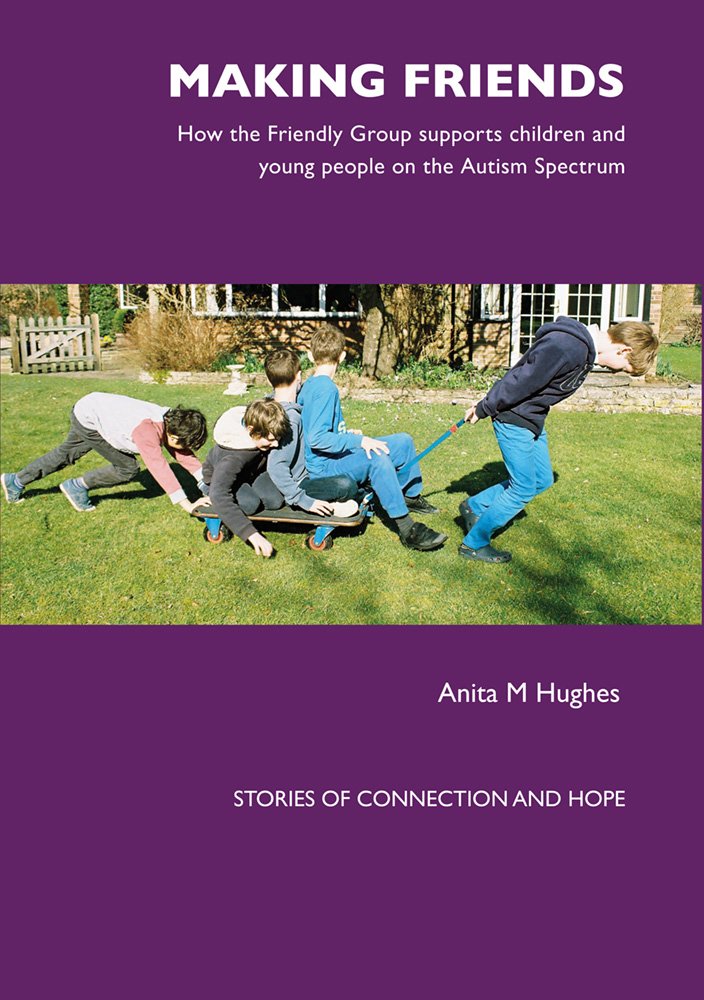
One of these encounters has led me to the astonishingly beautiful and moving work of Anita Hughes, whose book “Making Friends” I have just devoured on a sunny May Saturday.
Anita (her style and manner draw me to use her first name – I think of her as a friend I have yet, and hope one day, to meet) is an educational psychologist who has developed a social and therapeutic group “intervention” (oh my, how I hate that word, but it seems the closest fit for now) called “the friendly group”.
Thrilled and delighted at the notion of a therapeutic approach to friendship and social interaction for autistic children (well.. children who struggle with friendship), I ordered Anita’s book that very day. It arrived last week and has sat patiently on my desk awaiting the weekend and a few precious “free” hours.
I admit that initially I was a little daunted. I work hard, my home life continues to be quite intense demand significant emotional energy and I try to find time for creative pursuits that replenish me. So any additional moments are precious opportunities for rest and “escape”. Reading a non-fiction book that sits squarely in my world of work felt a little more like “homework” than “pleasure”.
Oh my goodness was I wrong!
Love, compassion, understanding and an uncompromising belief in autistic people’s desire and ability to make connection leaps our of every page.
I cried the bittersweet tears of recognition, nostalgia, hope and sadness while reading each chapter. I longed for time travel and the opportunity to offer such a chance to my children, while looking forward with excitement to acting on this newfound knowledge with my grandchildren.
Anita describes a simple (not easy) and effective approach to one of the biggest and seemingly intractable problems seen in schools: increasing numbers of children display social interaction difficulties and soaring anxiety.
We talk and talk of the epidemic of mental ill health in youngsters. We stress the need for emotional regulation, a “relational” approach to children and the importance of emotional wellbeing.
But we prioritise rules, uniformity, physical attendance, homework, grades, obedience…. all within an urgent need to adhere to a clear timeline.
Anita demonstrates how much can be achieved by protecting a couple of hours each week and affording children a one hour session in which time can pass at their pace within a clear structure. Freedom within boundaries…
It’s hard to see how any school could find this unmanageable.
There is so much learning in this book for me – both as a parent and as an advocate and consultant. For any parent, grandparent, family member of an autistic child (or adult. For EVERY teacher, practitioner, SEND officer!
I truly believe that Anita’s book should be compulsory reading for anyone working with autistic children. If only one of the gems in it were applied by each adult our children encounter, their lives would already improve.
I am left with so many questions! So many of the families I work with would benefit hugely from the Friendly Group, and Anita’s book gives a wonderful starting point for someone wanting to start their own. Maybe you, dear reader, have already done just that? What is your experience? Have you seen a similar approach to support older young people or indeed adults?
My journey does not end here. “Making Friends” made my Saturday more beautiful, but that is only the beginning. I look forward to finding out more, to seeking out “Friendly Groups” near and far and learning even more… and I urge you to join me on this journey!
Find Anita’s book here!
Exhausted? Are you looking after yourself?
We all have off-days. Or off weeks, months, years! Here’s a reminder to do the basics to look after yourself.
But I also remind myself when I feel exhausted that children with additional needs often feel that way all the time… it’s a good reminder of how they experience life and how we can help them.
Jargon… is it only for professionals?
As parent carers (and their representatives), we often ask professionals to avoid using jargon or acronyms. Apart from the fact that these make understanding difficult, acronyms in particular can mean many things.
In a recent example, my daughter was asked by her GP if she was using a wheelchair due to SPD.
Both of us immediately thought he meant “Sensory Processing Disorder” and were quite confused as to why that would require a wheelchair. It is one of her diagnoses.
In fact, he meant “Symphysis Pubis Dysfunction”. She was pregnant, and it was a reasonable assumption (correct, but not the primary reason for her wheelchair use).
Moral of the story: avoid acronyms!
But today I am thinking about language that parent carers begin to use which may not sound like jargon but is… and in the same way as medical or professional jargon, there is a huge risk that “lay people” will not understand. In this case, “lay people” include extended family, parents whose children do not have additional needs, teachers, therapists, doctors and all kinds of professionals.
Are we shooting ourselves in the foot by using such language, that feels really relevant, but that opens us up to misunderstanding and can even diminish our children’s needs in the eyes of others?
Masking
If you are the parent of a child/young person suffering from anxiety, or who has autistic or ADHD traits, you will be familiar with the notion of “masking”.
To ‘mask’ or to ‘camouflage’ means to hide or disguise parts of oneself in order to better fit in with those around you. It is an unconscious strategy all humans develop whilst growing up in order to connect with those around us.
However, for us autistic folk the strategy is often much more ingrained and harmful to our wellbeing and health. Because our social norms are different to others around us, we often experience greater pressure to hide our true selves and to fit into that non-autistic culture.
Dr Hannah Belcher, from the NAS website
“Masking” is a very real and traumatising strategy employed by any child who is suffering from anxiety, so it’s no wonder that parent carers use the word so frequently once they understand it. It describes the child who is “fine in school”, then arrives home sobbing uncontrollably, or so exhausted that they curl up on a sofa and stare into space for hours, or comes home screaming abuse at mum, hitting or breaking anything in their way.
My biggest lesson about masking has been the following: most people cannot control how, where or when they mask. Many are not even aware that they are doing it. This is particularly true of children.
Those of you who have been following me on my Tugboat journey will have gathered that I like to explore different perspectives on the same issue. Today is no different!
If you are a professional…
When you hear a parent talk repeatedly and with passion about something like masking, take a breath. Do not assume that they have jumped on a bandwagon, have “self-diagnosed” their child.
Try this as a starting point:
In front of you is a parent whose child is not happy. In response, this caring parent has possibly tried to ask for help, has researched their child’s behaviours and characteristics and has learned from other parents, from internet searches, from support groups. This is valuable evidence that can help you help the child – if only you accept it.
If you are a parent…
It’s so easy to overuse a term that fits so beautifully once you find it. And before you know it, in the world of social media, that word is EVERYWHERE. But do all those using it truly understand it?
I think it’s probably fair to say that most people have a vague understanding of “masking” now, in a way that they did not five years ago. But this means that it has become overused and for the most traumatised children, the word has become devalued. Don’t forget, too, that every single human being masks – it’s the reason we are able to be social creatures. But in our world of additional needs, we use the word to describe a child in fight/flight mode, who is leaning on a survival strategy day in day out. That causes trauma and will lead to serious difficulties.
In other situations, you will be talking to people who have no idea what you mean when you use the word. Often, these will be professionals, and they will be listening to you and coming to their own conclusions about the meaning. “Masking” is an active verb. It’s all too easy to understand it as a conscious choice made by an individual. So either the child has such good control of their emotions that they must be able to make other choices. Or they are defiant. Or they are manipulative.
It is our responsibility as parent carers, and as the person choosing the words we use, to ensure that they are understood in the way we intend.
Whenever I am talking to someone about my child’s “masking”, I start with an explanation of the term. I explain that in the case of an autistic child, masking is very much like a survival strategy that keeps them safe.
It’s rare that they are aware of doing it, only how very tired they are when they finally find themselves in a safe space.
For those children who are aware that they mask, many cannot control it. This adds a level of panic because they are not behaving in a manner true to themselves, but nor can they change their behaviour.
When the “mask” comes off, many children have a violently emotional reaction. Have you ever put your palm over a tap to stop the water coming out? When you remove your hand, how strong is the flow of water?
Most of our children struggle with communication and their emotions – far more so than “average” children. So when that mask comes off and they feel a gush of complex and often contradictory emotion, they are overwhelmed. It’s deeply frightening. So it’s no wonder that we parents are suddenly faced with children in meltdown or shutdown states.
Now I’ve explained what I mean by masking, I will try and take the time to check in with the person I’m speaking to. How does what I’ve said make them feel? Is it something they recognise? Have I made them think a little differently? It’s really worthwhile asking those questions out loud. Apart from anything else, if you treat someone in the room as an equal, they are rather compelled to do the same to you!
Only at this point will you be able to have a real discussion because you are now all speaking the same language.
Jargon goes both ways
Don’t forget to check your jargon! You may not even realise the words you are using are jargon to someone else.
Just like the seasons, everything changes
I love autumn because it’s the one season in which we can see things come to life at the same time as things dying. Autumn is the season of mushrooms and aren’t they just the most magical things? It’s also the seasons when many plants give a last flourish of colour before letting us know that they’ve had enough for a while.
Everything changes. All the time. From bad to better, from good to awful sometimes. From the known to the unrecognisable. It’s a simple sentence that has stood me in very good stead as I’ve journeyed through the complicated world of additional needs.
If you are in the depths of despair because your child is ill, or school just can’t see how to help, or a social worker thinks you are causing your teenager’s problems. Things change. They do not stay the same, so the pain you are feeling now will not endure. [It is possible they may get worse for a while, but the change in itself is usually helpful.] In reality, things do get better if only because as human beings we find ways to normalise our lives. It just makes things easier to manage.
A very good friend, Yvonne Newbold talks in her book about managing “ten-minute chunks”. We can all endure for ten minutes, so set your sights and your clock for the next ten minutes. Then breathe and see where you are.
I’m constantly amazed by how much better things can get if we just give them time. In terms of our children, it’s all too easy to be told that children with additional needs tend to need longer to mature, to develop. When your teenager is self-harming or running wild with people who frighten you, those additional years feel far away and unattainable. And yet… time and again those of us with slightly older young people will tell you that change of a kind they never imagined happened.
If the bad can change to good, there’s no shying away from the fact that good can change to bad too! All those interventions you put in place to support your autistic child, that were working so well, suddenly seem to be having no effect. Or sometimes, they are just making things worse! What happened?
What happened is that your child is growing. They are changing and as a result the interventions are not working anymore. Because your child is a wonderful, complicated human, not a robot!!
The same is true for children with physical needs. The physiotherapy programme implemented two months ago may now be causing pain, or be less effective because they’ve had a growth spurt. Which can be really frustrating if you’re not due to see the therapist for a few months! Don’t hesitate in such circumstances to make a phone call or send an email for earlier input.
Sometimes positive change is the scariest…
What if your child stops needing the support that has been critical to their wellbeing and progress?
What if that support has been so effective that your child no longer has the same level of need?
Is that a sign that it’s the right support and is allowing them to progress and thrive? Or has it outlived its usefulness?
Our systems in the UK make it very difficult to access specialist support, and all too easy to lose it. Unfortunately, that means that we parents are terrified to reduce provision that has been hard-fought and has made a positive difference. Even if it’s the right decision.
One of the hardest things to do as a parent carer is to recognise the time to let go. The time to take a risk, a chance, to trust our child and the people who are helping them. Even if a therapist you trust tells you that they no longer need to see that child, every cell in your body may well scream in protest. Personally, I believe that if support were easier to put in place, we parents would not fear this part of the process nearly so much….
It is a risk, to take away some of the scaffolding. In the same way as removing a plaster cast and crutches may result in a fall, removing assistance, or a therapy session may well result in some difficulties. But let’s stick with the broken leg analogy, because it’s easier to understand.
Having a leg in plaster allows broken bones to knit together and mend BUT… that same supportive plaster cast results in muscle wastage. When the plaster comes off, mobility is affected. Your leg will no doubt hurt, as will your hip and your back. Your arms probably hurt because of the crutches you had to use. In many ways, your whole body has been badly affected by the treatment used to deal with the crisis that was your broken bone.
Proper recovery to independence depends on your work. Your willingness to push through the pain, to walk in spite of the wobble. You may need to use crutches a little longer, then graduate to a single stick until finally you walk alone, if slowly. But if you do the work, if you are brave enough to move with the discomfort, you will learn to walk again.
I’m a parent carer. I often fall into the trap of supporting for too long, or too much. Because I love my children and I have seen them struggle and suffer far more than their peers. I often have to remind myself that my goal is for them to live as independently as they can. And that depends on my ability to step away from them, to give them the space of moving with discomfort.
Going Backwards never really works
I’ll leave you with a little thought. One of the fears in considering the reduction of support is that you will have to fight to get it back.
I would suggest that you will never need or want the precise support that you are reducing, because your child is not the child they were a year ago, two years ago. You may well have to advocate for additional support if things don’t go to plan. But it won’t be going backwards. You will be asking for something new, that suits your child’s needs now.
So in reality, you’re not losing anything. Try and be brave. Try and consider that those professionals working with your child have seen progress that suggests a plaster cast can be removed. Maybe it will be replaced with a splint. Maybe the leg will be left bare, and a few days later you will explain to the doctors that something more is needed (a splint, different painkillers). It’s even possible that another plaster cast will be required, but if it is, it will be a different shape, because the leg is not the shape it was when the first one was applied.
Advocacy and disability are not static. We often enter this world as we would start a sprint. Get your head down, run hard, do the work and get to the finish line. But the reality is that parenting a child with additional needs is closer to a marathon and closer still to an endless hike. So we need to learn to be flexible so that we can adapt to ever changing circumstances, and relax into what is a challenging but rewarding life.
Risk: finding the balance between benefit and harm
The Oxford Learner’s Dictionary defines risk in this way:
- the possibility of something bad happening at some time in the future
- a situation that could be dangerous or have a bad result
As parents of children with additional needs, we live with “risk” all the time. Bad things happen to us and our children rather more frequently than they do in more average families for a number of reasons including:
- Our children may have medical conditions that cause pain, loss of function, or require treatments that have side effects and can be traumatic.
- Our interactions with the systems in place to help us often do not go the way we hope, and that can have devastating implications for our children.
- Some of our children have a different experience of the world and can put themselves or others at risk of danger or harm.
So in today’s world, parent carers can be or appear to be risk-averse. Which is seen as a bad thing. Risk is important for growth, we are told. Don’t be over-protective, over-anxious…
Parent carers are also, regularly, told that they are not being careful enough, that there may be “safeguarding” issues, that such and such a situation is not safe. Don’t be neglectful, don’t risk your child’s safety…
Hang on, back up a moment…. How many of you have noticed the dreadful contradiction?
It’s a legitimate question. I’ve spent the last twenty years living with these messages and simply accepting the fact that I might well be both over-protective and in some way neglectful of my children. Many of us do. But if we are able to take a breath, pause and reflect, we will quickly understand that there is something quite wrong here.
Overprotective parents show guarding behavior that is excessive considering the child’s developmental stage and the actual risk level in their environment.
https://www.parentingforbrain.com/overprotective-parents/
Uninvolved [or neglectful] parenting is a parenting style characterized by low responsiveness and low demandingness.
https://www.parentingforbrain.com/uninvolved-parenting/
The missing link for me in this conversation is the circumstances of a family. If your child has additional needs, your parenting is likely to be extreme, because your child’s needs are not straightforward, because you now have to develop “carer” relationships with outside agencies as well as “parent” relationships with your wider family. You have to juggle emotions, physical realities and systems that most families never encounter.
And yet, everyone around you will try to simplify your parenting to fit those simpler families. Even the best professionals find it difficult to fully understand the complexities you are dealing with every single day.
If you are a professional…
Take the time to get to know the family, or to understand the immediate situation. Let me give you an example:
Miss B is a reception teacher. She has created a fun, nurturing classroom and is passionate about inclusion. She loves all the children in her class and has a particular fondness for those who are a little different. When the children are in class without their parents, all seems fine. Some children may be quieter, but she is providing a tolerant and inclusive space that allows different forms of expression.
J’s mother is frequently very distressed when bringing him into school. She talks about J not feeling safe, she does not agree that he is “fine” in school because he is very sad, upset or angry after school.
Both Miss B and J’s mother have his best interests at heart. But Miss B sees J’s mother as over-protective because her classroom is a safe space and J does not have any behaviour issues at school and gets on with his work. In her eyes, school does not pose any risk.
J’s mother’s day is far, far longer than Miss B realises. J did not sleep, again, because he was so scared to go to school. He may have been unable to eat because his tummy hurts so much. He may have run away into the road on the way to school. When he comes home, he may be hurting himself or his siblings as his anxiety turns to anger and lashing out in the safe space of home. J’s mother has noticed over time that J is much calmer during holidays, but his anxiety escalates in the days leading up to school. In her eyes, school is a highly risky environment.
This post isn’t so much about finding solutions. Today, just try and notice the different perspectives of those you are trying to help. Try and understand that risk is to some extent about perception, and if a parent carer feels that a situation is risky, then it must be considered this way to make progress.
If you are a parent…
I know that you are aware of risk. You live with it all day, every day, and you are doing an AMAZING job. Because the overwhelming majority of you are absolutely not over-protective. Your are protecting your child, because that is your role as a parent.
That said, I’d like to give you a little something to ponder, to think about in the rare moments that you have time to allow your brain to pause and consider the future (even if the future is only tomorrow, or next weekend).
Risk is also opportunity. Risk is the gateway to growth. And risk does not have to be taken alone.
School may well feel incredibly risky to your little one. And it’s important to acknowledge that, understand why and do your best to reduce whatever is making them feel unsafe. At the same time, you know that Miss B is a good teacher who cares. So how can you lead your child into a situation that you know to be safe, but they feel to be dangerous? Can you lead them into risk so as to make it accessible?
A number of years ago, my youngest was due to go on a school trip for a few days. His medical conditions were complex but the key issue for me was that he was tube fed. He needed regularly tube feeding, and he was fed by pump overnight. I raised the following risks with school:
1. He tended to get tangled up in tubing during the night, sometimes around his neck. I managed that risk as best I could at home, but if he was going away with school, they needed to be aware of potentially fatal risks – how would they manage it?
2. If his “button” (feeding tube) came out, he needed to be within 20 minutes of a hospital. The holiday centre was not, and I realised that the only option in this scenario was a medical helicopter…. quite the thing!!
My son was very anxious about the trip for these reasons but I felt it important that he have the same opportunities as the others (putting my own anxiety aside!!). The next few months became a long effort to help him take risk “safely” and to help school understand that the risk was real and needed serious management.
My solution was to offer my time. I was willing and able to join the group to manage these risks. Sadly, this was initially seen as “overprotective parenting”, but when no other option was put forward, my solution was the one we all agreed to.
It’s important to note. I didn’t join any of the day excursions. I was simply on call in case his button fell out, and I had responsibility for him overnight. Did it go perfectly? No. Were there problems? Yes – but they were small and I allowed school staff to take those risks, make mistakes because life is messy. The important thing is that his life was not at risk.
And then they start growing up…
Every teenager and young adult takes risks. Stupid risks. They make bad decisions and there are consequences – sometimes very serious ones. It’s an important and necessary part of growing up and I think that often it’s a step we or our children try to bypass.
Despite disability, our children will never be able to move into adulthood if they have not had a period of adolescence, of which risk-taking is a crucial part.
Our job as parents is to find the balance. What is the risk they are taking? How can we support them to understand the possible consequences? What responsibility can they have for themselves and what part do we have to retain?
These are incredibly difficult questions and for some young people, there will need to be discussions about their mental capacity to take risk and make decisions. But for the majority, we dance to a much more subtle tune that is fraught with fear for our young people. My experience is that teenagers respond incredibly well to trust and gentle “backseat” support. They want to lead their own lives. To some extent, our job is to allow them to do that and be prepared to help them pick up the pieces if things go wrong.
I’d love to hear your experiences, thoughts, hopes and fears about risk when it comes to children and young adults with additional needs… Comment below!
Parent? Carer? Who’s having an identity crisis?
A carer is anyone, including children and adults who looks after a family member, partner or friend who needs help because of their illness, frailty, disability, a mental health problem or an addiction and cannot cope without their support. The care they give is unpaid.
NHS England
That sounds easy, doesn’t it? If your partner or parent becomes ill and you need to help them, you are a carer. Even in those circumstances, it takes an average of 2 years for someone to realise and accept their new role.
Now imagine that the person requiring care is your child… maybe a baby? How do you disentangle caring responsibilities from parenting responsibilities? After all, no baby can cope without support!
Very few parents of disabled children view themselves primarily as carers. They are simply parents. The fact that parenting in these circumstances bears little resemblance to the experience of others feels irrelevant. We love our children and we will look after them according to their needs.
So why is it sometimes important to differentiate between “parent” and “carer”?
And how can you do it?
Disability in children presents in an infinite variety of ways. This blog is by necessity very general, so you may not recognise your circumstances in what I write. In the blog, I’m trying to be as broad as I can, which can mean that I’m referring to less complex cases. Each family will have a set of unique issues that need considering on their own merits, but hopefully this will give you some points to think about…
The Early Years…
Differentiating parenting from caring is much more straightforward with a very young child than later on. The primary needs of feeding, changing, sleeping are largely universal even if your baby or toddler is struggling more than most. You will be spending your time nurturing, reassuring and showering this little bundle with love, all of which sits quite easily under the “parenting” heading.
If your little one has medical issues, the “caring” responsibilities are quite clear. You may have to learn how to tube feed, how to change dressings, how to clear an airway. All clearly tasks that are considerably different to “parenting”. In this scenario, you will also be surrounded by a medical team. There is no doubt that this kind of parenting is extreme and you will also find yourself advocating for your child as you learn more than you ever anticipated in order to keep them safe. For any of you in this situation, I highly recommend The First Breath by Olivia Gordon, who gives a beautiful account of the intertwining relationship between parenting and caring.
For others, you will find yourself parenting in a way you hadn’t considered, but feels reasonably easy because you are responding to your child’s needs. They may not like being around people, they may shy away from certain sounds, clothes… and you just adjust, because you are parenting.
The world has yet to encroach on the family you are building. Demands are fairly low and you are able to enjoy being a parent… albeit you may have noticed some differences between your family and those around you.
Tests and checks and expectations…
As time goes by, systems begin to encroach. Health visitors, quite rightly, will want to see children reaching certain milestones in the “right” order, at the “right” time. In other circumstances, you will have notices things that don’t feel “right” and you may already be fighting to be heard.
And now you have to develop two identities:
Parent: nurturing, observant, anxious when things aren’t right, seeking answers and help.
Carer: objective, clinical, evidence-based, advocate. Because without these qualities, your voice may well go unheard.
There is huge overlap between these two roles, as well there should be. But many of us soon discover that our role as parent is very quickly dismissed. There may well be much talk of “you know your child best”, but when you sense a serious problem chances are that you will be branded an “over-anxious parent”.
As time goes on, more people enter your life and more checks, tests and expectations appear. Some of these will be truly welcome, especially if you have been begging for acknowledgement and help. Some will blindside you. Some will feel intrusive and unwanted. You may find yourself wishing you could stay in your family bubble, where everyone felt safe and accepted as they are.
You as a Carer
One of the most important roles you will develop as a carer is that of Advocate. You will be your child’s voice, you will be there to ensure everyone knows when their needs change, or are not being met. With that comes the role of Protector. Many of our children need to be protected from the onslaught of professionals, tests, systems so that they can simply be children. Finding the balance between the necessary appointments and those that could be handled differently will be one of your superpowers.
You will become and Administrator. Reams of paper will appear through your doorstep, emails will fly through the ether to your inbox. If I can offer one piece of advice here, it is to find a way to file all these pieces of information in a way that works for you. Evidence is going to be a word that you will simultaneously love and hate, and each letter is a piece of evidence…
In my more organised days, the following system worked very well indeed. I had one for each child. Each month had a separate folder or part of a file, with a sheet of paper at its front. Whenever a letter appeared, I would note the date, professional and summary on that sheet of paper. I then filed each letter chronologically.
You will learn more about your child’s condition than most professionals will know. This makes you an Expert Parent and you will gain strength and confidence from that label if you can truly believe it. Click on the link to find information about training events that can help you.
Maybe the most fundamental attribute that you will develop as a Carer is the ability to Challenge the Systems.
You as a Parent
Parenting is a complicated business, and there are many different “styles” of parenting. But at its heart, parenting is about supporting your child to become an independent adult. It’s a LONG process, that changes depending on your circumstances, your child’s age and needs, the society you live in and even your local community.
Add in disability, and you must also add in a host of observers to your parenting. Healthcare professionals, social workers, school staff, charity workers will all be part of your life and, whether you like it or not, they will also affect your parenting.
All too easily, your “parent” self may well become smaller and smaller.
With a little bit of hindsight now my children are on the cusp of adulthood, I think the one ingredient to look out for it: FUN!
Going out was always really difficult with my three… so we tried (too rarely) to have fun at home. One of my favourite go-tos was the bathtub.
Food colouring when I was out of bath bombs – or we made our own!
Picnics in the bath. Yes. We got favourite messy foods and just ate in the bath. Food fights and generally making a mess was good for everyone.
My children LOVED playing with cornflour and toys like cars. The bath was a wonderful place to make more mess.
Potion making is probably the best. Gather cheap bubble baths, ends of soap bars and old bottles (or better still ask friends who use hotels to collect any small bottles), and make potions!
If you have stopped having fun, it may be time to have a look and see where your parent self is hiding. It may be time to put your carer self in the passenger seat, if only for an hour or so.
Parent carers are never alone…
One of the most challenging things about being a parent and a carer is that you will be faced with many contradictory messages. And you may well find yourself unable to make decisions alone. What is a simple parenting decision for many becomes a minefield of caring and safeguarding questions where the opinion of several official departments will play a part in your decision.
For example, many people will tell you that part of parenting involves teaching your children to do new things – some of which may well be risky!
Parts of the SEND system will be suggesting that you are being too protective and slowing your child’s independence – but other parts of the system may well be concerned that you are putting your child “at risk” and talking about safeguarding issues.
The reality is that parenting and caring for a child with additional needs are always intertwined, and that many of us are caught in a fishbowl that tremendously limits our options. It can be really helpful to stop and remember that. Remember that as a carer, your parenting choices and independence may be limited through no fault of your own. And don’t hesitate to remind those around you of that reality…
And You as… You???
A big topic for another day. When the evening comes and you are reaching the end of the day’s parenting, maybe a lull before a night of caring, ask yourself: did you give any time today for “you”?
In the midst of caring for complex little people (often more than one), we simply lose ourselves. I’d like you to share a moment, a thought, for the unique and wonderful person that is you. She or he may be in hiding at the moment, or hibernating while you concentrate on keeping your children alive. But she or he is still there somewhere, waiting to emerge once again. I wonder who she is, what he likes? I wonder how you are changing in response to this strange world you inhabit as a parent carer?
School Avoidance Awareness Week
I’m so pleased to share links to a wonderful organisation, Sunshine Support, and their recent initiative to highlight a growing problem in the world of additional needs: children who cannot attend school.
I love Sunshine Support’s approach, which is very similar to the work I do with Tugboat, if more established. Do have a look at the webinars they offer!
I chose to speak on this subject at the end of this awareness week deliberately – because the problems faced by children and families will not disappear next week or the one afterwards. It’s really important that we continue to tackle these issues even when the spotlight is not on them.
To change things up a little, I thought I would have a spontaneous chat with you on the subject:
When feelings, thoughts and reality collide
A few years ago on a Friday afternoon, I received an email telling me that my child would not be going to the school that I had pinned all my hopes on.
[PSA: I am talking about school choices for children with additional needs and disabilities for whom choices are remarkably limited.]
The air was sucked out of my lungs. The ground fell away from me. Suddenly my vision narrowed to a pinprick in front of me. I couldn’t feel anything and at the same time my skin was alive with painful touch. The textbook description of a panic attack, I felt not only as if I were dying, but as if my child, husband, other children and extended family were dying.
Literally. By which I mean everything in my body was telling me that we had reached the end of life.
Many of you will read this and scoff, thinking what an overreaction I was having. The kinder among you will pity me and the extreme anxiety I was feeling – I must have an underlying anxiety disorder. Some will knowingly tut and explain that this is exactly why it’s important not to develop an “overprotective” parenting style.
The reason I bring this up today is that time has helped me see the bigger picture and I think it’s worth exploring, whether you are a professional supporting a family, a parent waiting for this kind of decision, or a parent in the midst of that gut-wrenching panic.
Feelings
I’ve described to you in my opening paragraph the sensations in my body on reading that email. My feelings were not actually even engaged at this point. My lizard brain was in complete control. It had assessed the situation and concluded that we were dying. Quite rightly, it had then engaged any and all survival mechanisms (possibly too many at a time!!), which importantly disengages the owl brain (Owl usually wants time to think, by which time the tiger has eaten you). There are loads of videos on YouTube and other platforms that talk about this, but here’s one to get you started.
Eventually, my heart rate settled a little, and all of those fight/flight symptoms reduced just enough for my Dog brain to get a look in and turn the sensations and input into emotions, feelings. Let’s take a look at what my Dog brain was telling me:
Devastation: I felt as though the world had caved in. All my hard work had been ignored, all the building blocks I’d so carefully put together had been swept aside. I was back to square one, much like Sisyphus.

Sadness and isolation: I didn’t have a plan B. Not because I desperately wanted plan A, but because plan A had been the only one I’d found – and nobody had suggested another plan. I felt terribly alone and just wanted to cry.
Frustration: I felt completely unheard – my flawless, calm and quiet logic had been ignored.
Anger: How dare the system, the people not listen to my clear, considered arguments? How dare they suggest something that ignored all the evidence I had presented and the risks that came with their ideas?
Despair: Where next? And this was really where I landed. There’s little progress to be made from despair because despair is the land where Hope goes to die….
From Despair, I reached out to a wonderful friend, knowing she would understand. She had been in my shoes and she would know what to do next. I will be forever grateful for her response which, at the time, filled me with a sense of shock and betrayal.
“It’s not the end of the world!”, she said, “Just because it isn’t the path you have chosen doesn’t mean that it will be the wrong one.”
She had the luxury of not sitting in the toxic hormonal soup of panic, or in the painful moment of emotion. She had experienced similar situations and had survived… and her Owl brain was alive and well and could see far further than my extremely limited vision.
This amazing friend is Yvonne Newbold of Newbold Hope, who helps thousands of families understand and support their children… Go visit!
Thoughts…
Eventually, panic subsides. It just does. We are not designed to live in a state of heightened panic and we find ways to normalise any situation that we sit in for a period of time. And when panic subsides, the emotions start to allow room for thinking.
My Owl brain loves this bit. It comes in, the conquering hero, almighty rescuer, knight on a white horse:

“I can fix this! No problem is too big for me! I will find the right name, email, person and I will correct this Gross Injustice!”
Of course, it then came to a screaming stop as it realised that nothing happens between a Friday afternoon and a Monday morning… As it happens, in this situation, I was able to find someone to speak to and eventually after much discussion, the local authority “conceded”. They agreed that my preferred school was the best option.
But. But. But. Before you allow your Dog brains free reign…
(The professionals among you will no doubt be feeling that here is another pushy parent who has got her way, where many parents don’t have the resources to push like that – how unfair!
The parents among you may be whooping, thoroughly vindicated in the knowledge that once again, the evil and stupid Local Authority has been shown its inadequacies!)
Reality
Because our SEND systems are truly bogged down, mired in bureaucracy, deadlines, poor resource and all manner of irksome nonsense, nobody had the time or knowledge to sit down with me and have a proper conversation.
We continued on the path that I had identified as most likely to help this young person. It was not a failure. Nor was it a success.
With the privilege and value of hindsight, I can now say with absolute certainty that the initial proposal would not have resulted in anybody’s death. I suspect it would have caused far more problems than the path we followed.
I am also quite sure that if we had worked together, we could have found a compromise.
I was left to figure out the Reality of my situation on my own. There was no advice to be had that could in any way be deemed impartial or indeed focussed on my child’s true best interests. Far too few people in this system have enough knowledge of the breadth of additional needs, or indeed the various educational settings or alternative pathways to advise those of us with complicated young people.
So we muddle our way through and find it increasingly difficult to lift ourselves out of our emotional muddle to be able to see the wood for the trees…
What next?
If you are a parent reading this, let me gently suggest a couple of things:
- Use all the strategies you know to calm your brain. You will make better decisions if your Owl brain is in charge.
- What is the worst thing that can happen? Not next year, not next month, but right now, and tomorrow? Facing the thing you fear most will likely rob it of its power over you and you will be better equipped for the next step.
- Talk to someone who can help you see the wood, the forest rather than the multitude of trees that are in your way. We all need help to see the big picture, and that allows us to make better decisions.
If you are a professional working with a family – closely or merely by email:
- Please avoid sending such emails at the end of the week. It’s true that we may have calmed down by Monday, but that will be at the expense of our physical and mental health. Give us the opportunity to call you and share the sense of panic.
- Be ready to offer reassurance in the form of continued conversation. Remain open. Have you really heard everything we are trying to let you know?
- Do your research. Do you truly understand my child’s needs? Do you truly know the provision available? Be prepared to offer alternatives, not because they are the only things you know of, but because you truly believe that they can work.
It can be very difficult, in the midst of a panic attack, to believe that life goes on. But it does! And our capacity to adapt never ceases to amaze me… everything passes and if you are feeling at your worst, I guarantee that you will feel better…
Time for you
Being a parent is a full time job – we know this.
Being a parent carer is the same – on steroids!
Our children with additional needs also require additional time. Additional attention, additional affection, additional looking after.
So how do you find the essential time for yourself, your partner, your friends that will allow you to be the parent you want to be?
In a world of compromise I’ll offer a few ideas that helped me from time to time. Let me know in the comments of things that have worked for you!
- Develop the idea of “quiet time”. Maybe start with snacking after school with your children, chat about your days. Then everyone goes to their room, their space for 10, 15, 30 minutes to rest, process and reset before coming back together for the evening. As time goes on, you’ll be able to have an hour of quiet time that you can use to enjoy their presence without them clamouring for your attention.
- Consider “joint journalling”. Many of our children suffer from separation anxiety – it’s a real thing that we need to be very careful with. If you decide together what your creation will be (for example, today’s theme might be the weather), then go to your separate spaces for 20 minutes to draw, paint, write your part of the journal. Then come back and compare, add each part to your joint journal. Your child will know that in that 20 minutes apart from you, they were your sole focus. Slowly they can learn that you exist away from them, and you still care about them when you can’t see them.
- Community… this is a huge one. How many families do you know from your child’s school. Even in primary school this is a really tough one for our families. Maybe ask your child’s teacher to help you make links with another family. The SENCO (special educational needs coordinator) might put you in contact with other families like yours, but don’t discount the value of making friends in the wider world.
- Extra-curricular activities. Be they after school clubs, scouts, short breaks for disabled children, these are a breath of fresh air for all parents and should be available to our children too. You may need to talk to the organiser about your child’s needs, or even talk to the school about a shorter school day to make such a thing possible. But be brave – talk to people about what’s out there.
- Baby-sitting. This can be impossible, or seem impossible. But even if you do not have family that can help, it is likely that one of the teaching assistants at your child’s school would be more than happy to help out. There may be some charities that can offer support, but if you’re able to use the people in your immediate community, it will last longer. Start by having the babysitter help out with your normal afternoon or weekend routine. Eventually, you’ll be able to leave the house for ten minutes, then long enough to run a small errand. Build up slowly, and you will be able to manage a proper outing. Bear in mind that there are also agencies that offer specialised babysitting.
Who are you? What do you want to do?
It’s really important for any parent to try and hold on to a sense of identity. Many of us forget that, and it can be very painful to “wake up” one day and discover that we have invested our whole being into parenting. Because whatever the degree of need our children have, they will eventually be grown… and we can find ourselves lost, alone and very much on the verge of despair.
So here’s my challenge today: who do you want to be? What hobbies would you like to try? What was your passion before having children?