A very long time ago, once upon a time, in the depths of the fog of the great long past, I was a young mother. I had two little children who were growing up and learning and causing the usual havoc that toddlers do.
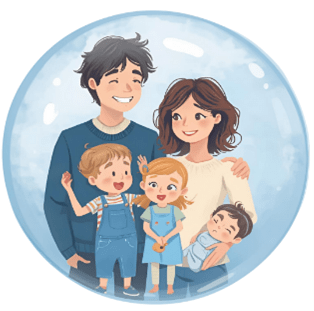
We lived in the beautiful bubble of home that so many young families enjoy. We saw grandparents every few weeks. We went out of the home to see other parents, to go to the park or for playdates with the children. We created a cosy, safe place at home that was ours alone, as so many families do.
And then Little came along…
While I was expecting number three, we realised that Eldest was struggling, both at home and school. He was different from his peers in ways difficult to pinpoint: his behaviour was tricky, he wasn’t sleeping very well, he was “too clever” and didn’t understand the difference between children and grown-ups. So began meetings with teachers and doctors and intrusions into that bubble that was home.
And then Little came along…
Eleven weeks later, Little was rushed to hospital and diagnosed with failure to thrive (bad mother!), a heart defect and leukaemia (“can’t you see he’s dreadfully ill?” – bad mother!).
My older two were thrown into strangers’ homes to allow me to go to hospital visits. The strangers were known and safe villagers, but nevertheless strangers to me and the children. Asking for help was not a choice, but a necessity and I had to accept it from wherever it came. “Act now, ask questions later” became a necessary survival technique.
Time wore on and we got into the rhythm of hospital visits. We moved country, we moved house, we moved hospitals, and doctors and nurses. All with Eldest, Girl and Little under the age of 4.
We are human and we couldn’t keep going without help.
So I took a deep breath. I knew that help would mean allowing people into our home bubble. I knew that people would look at the dishes in the sink and likely “tut”. I knew they would look at the mess on the table, the floor and their eyebrows would rise to the ceiling. They would see the pile of sheets covered in vomit and wrinkle their noses. But I knew I could not keep going alone much longer.
So I called the health visitor. And the church. And from there we say nurses, and social workers, and carers, and therapists. And because the world is what it is, most of those lovely people moved on to other things after a while, so I would meet a new nurse, social worker, carer, therapist, teacher, teaching assistant, support worker… oh another nurse from another department!
I now work as an advocate supporting families like mine. In this video I explore the cost of asking for help from that perspective…
I made the decision to ask for help 22 years ago, almost to the day. Since then, my home bubble has been open to the world and I have been open to a parade of well-meaning strangers’ judgements.
I am grateful beyond measure for all their help and I hold them very dear in my heart. But the cost to my family of that help? It was our bubble, our “safe” space, our little world to which we could retreat. And that should never be underestimated.
One of the most common themes I encounter as a parent carer and as an advocate for other parents and disabled people is a profound social and emotional isolation. Our lives are just different or chaotic enough to preclude the chats at the school gate, visits to the park or gentle walks to the shops in which small words and conspiratorial glands lead to play dates and friendships both between children and parents.
Instead, we find ourselves apart, “othered” by our circumstances. Our children all too often struggle to make or maintain friendships and we retreat from a world that seems to find us “too much”… or simply misunderstands and maybe fears us.
In response to this experience, I have become hyper-vigilant and hyper-aware of any opportunity for connection. I am primed to notice any potential path to friendship. As a result, I experience serendipity on an unusually frequent basis.
Serendipity: the occurrence and development of events by chance in a happy or beneficial way
In reality, serendipity is closely associated with its human element – one must be open to such happy discoveries in order to notice them even when one is not looking for them!
Much of my work relies on an expectation that there will be support somewhere, that there are always “next steps” in the face of hardship, suffering and despair. And sometimes, those next steps are very tiny and unexpected. Many of the families I work with have almost unknowingly found their solutions before I meet them, but not recognised the remarkable work they are doing. So initially, I take the time to help them see the love and dedication they have and are showing for their children: the research into their children’s “conditions”; the time taken to consider previously unconsidered parenting styles or “therapies”; extra-curricular activities, tutors, clubs that they never realised existed.
In turn, I share the knowledge I have garnered over more than twenty years. That might be in the form of tiniest tips to support a child in meltdown, or formal work to ensure public services are doing as they should. It could be finding the elusive “self-care” that we all speak of so highly but struggle to implement. And often, it’s about signposting a family to resources that are only catalogued in our collective mind – the community knowledge that is so difficult to create these days (no, the “local offer” websites do not solve this problem – a discussion for another day!).
Through all of this, the connection I forge with these families is all the stronger when it is dynamic. By learning from them, I empower them with the realisation that they can do far more than they believe themselves able. And in that relationship, my hope is always that they feel able to continue their journey without me – when the time is right for each.
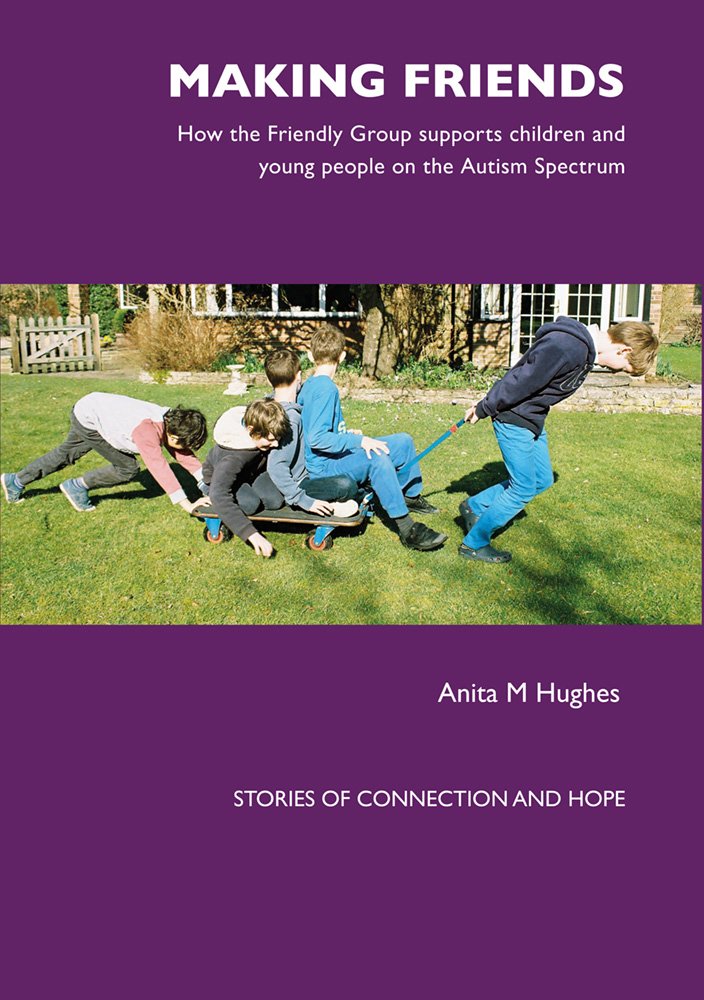
Note to those Wise Ones who choose to read this book – pay attention to the photograph, especially to the “trolley”!
One of these encounters has led me to the astonishingly beautiful and moving work of Anita Hughes, whose book “Making Friends” I have just devoured on a sunny May Saturday.
Anita (her style and manner draw me to use her first name – I think of her as a friend I have yet, and hope one day, to meet) is an educational psychologist who has developed a social and therapeutic group “intervention” (oh my, how I hate that word, but it seems the closest fit for now) called “the friendly group”.
Thrilled and delighted at the notion of a therapeutic approach to friendship and social interaction for autistic children (well.. children who struggle with friendship), I ordered Anita’s book that very day. It arrived last week and has sat patiently on my desk awaiting the weekend and a few precious “free” hours.
I admit that initially I was a little daunted. I work hard, my home life continues to be quite intense demand significant emotional energy and I try to find time for creative pursuits that replenish me. So any additional moments are precious opportunities for rest and “escape”. Reading a non-fiction book that sits squarely in my world of work felt a little more like “homework” than “pleasure”.
Oh my goodness was I wrong!
Love, compassion, understanding and an uncompromising belief in autistic people’s desire and ability to make connection leaps our of every page.
I cried the bittersweet tears of recognition, nostalgia, hope and sadness while reading each chapter. I longed for time travel and the opportunity to offer such a chance to my children, while looking forward with excitement to acting on this newfound knowledge with my grandchildren.
Anita describes a simple (not easy) and effective approach to one of the biggest and seemingly intractable problems seen in schools: increasing numbers of children display social interaction difficulties and soaring anxiety.
We talk and talk of the epidemic of mental ill health in youngsters. We stress the need for emotional regulation, a “relational” approach to children and the importance of emotional wellbeing.
But we prioritise rules, uniformity, physical attendance, homework, grades, obedience…. all within an urgent need to adhere to a clear timeline.
Anita demonstrates how much can be achieved by protecting a couple of hours each week and affording children a one hour session in which time can pass at their pace within a clear structure. Freedom within boundaries…
It’s hard to see how any school could find this unmanageable.
There is so much learning in this book for me – both as a parent and as an advocate and consultant. For any parent, grandparent, family member of an autistic child (or adult. For EVERY teacher, practitioner, SEND officer!
I truly believe that Anita’s book should be compulsory reading for anyone working with autistic children. If only one of the gems in it were applied by each adult our children encounter, their lives would already improve.
I am left with so many questions! So many of the families I work with would benefit hugely from the Friendly Group, and Anita’s book gives a wonderful starting point for someone wanting to start their own. Maybe you, dear reader, have already done just that? What is your experience? Have you seen a similar approach to support older young people or indeed adults?
My journey does not end here. “Making Friends” made my Saturday more beautiful, but that is only the beginning. I look forward to finding out more, to seeking out “Friendly Groups” near and far and learning even more… and I urge you to join me on this journey!
A few years ago on a Friday afternoon, I received an email telling me that my child would not be going to the school that I had pinned all my hopes on.
[PSA: I am talking about school choices for children with additional needs and disabilities for whom choices are remarkably limited.]
The air was sucked out of my lungs. The ground fell away from me. Suddenly my vision narrowed to a pinprick in front of me. I couldn’t feel anything and at the same time my skin was alive with painful touch. The textbook description of a panic attack, I felt not only as if I were dying, but as if my child, husband, other children and extended family were dying. Literally. By which I mean everything in my body was telling me that we had reached the end of life.
Many of you will read this and scoff, thinking what an overreaction I was having. The kinder among you will pity me and the extreme anxiety I was feeling – I must have an underlying anxiety disorder. Some will knowingly tut and explain that this is exactly why it’s important not to develop an “overprotective” parenting style.
The reason I bring this up today is that time has helped me see the bigger picture and I think it’s worth exploring, whether you are a professional supporting a family, a parent waiting for this kind of decision, or a parent in the midst of that gut-wrenching panic.
Feelings
I’ve described to you in my opening paragraph the sensations in my body on reading that email. My feelings were not actually even engaged at this point. My lizard brain was in complete control. It had assessed the situation and concluded that we were dying. Quite rightly, it had then engaged any and all survival mechanisms (possibly too many at a time!!), which importantly disengages the owl brain (Owl usually wants time to think, by which time the tiger has eaten you). There are loads of videos on YouTube and other platforms that talk about this, but here’s one to get you started.
Eventually, my heart rate settled a little, and all of those fight/flight symptoms reduced just enough for my Dog brain to get a look in and turn the sensations and input into emotions, feelings. Let’s take a look at what my Dog brain was telling me:
Devastation: I felt as though the world had caved in. All my hard work had been ignored, all the building blocks I’d so carefully put together had been swept aside. I was back to square one, much like Sisyphus.
Image by Camille Bissuel
Sadness and isolation: I didn’t have a plan B. Not because I desperately wanted plan A, but because plan A had been the only one I’d found – and nobody had suggested another plan. I felt terribly alone and just wanted to cry.
Frustration: I felt completely unheard – my flawless, calm and quiet logic had been ignored.
Anger: How dare the system, the people not listen to my clear, considered arguments? How dare they suggest something that ignored all the evidence I had presented and the risks that came with their ideas?
Despair: Where next? And this was really where I landed. There’s little progress to be made from despair because despair is the land where Hope goes to die….
From Despair, I reached out to a wonderful friend, knowing she would understand. She had been in my shoes and she would know what to do next. I will be forever grateful for her response which, at the time, filled me with a sense of shock and betrayal.
“It’s not the end of the world!”, she said, “Just because it isn’t the path you have chosen doesn’t mean that it will be the wrong one.”
She had the luxury of not sitting in the toxic hormonal soup of panic, or in the painful moment of emotion. She had experienced similar situations and had survived… and her Owl brain was alive and well and could see far further than my extremely limited vision.
This amazing friend is Yvonne Newbold of Newbold Hope, who helps thousands of families understand and support their children… Go visit!
Thoughts…
Eventually, panic subsides. It just does. We are not designed to live in a state of heightened panic and we find ways to normalise any situation that we sit in for a period of time. And when panic subsides, the emotions start to allow room for thinking.
My Owl brain loves this bit. It comes in, the conquering hero, almighty rescuer, knight on a white horse:
“I can fix this! No problem is too big for me! I will find the right name, email, person and I will correct this Gross Injustice!”
Of course, it then came to a screaming stop as it realised that nothing happens between a Friday afternoon and a Monday morning… As it happens, in this situation, I was able to find someone to speak to and eventually after much discussion, the local authority “conceded”. They agreed that my preferred school was the best option.
But. But. But. Before you allow your Dog brains free reign…
(The professionals among you will no doubt be feeling that here is another pushy parent who has got her way, where many parents don’t have the resources to push like that – how unfair!
The parents among you may be whooping, thoroughly vindicated in the knowledge that once again, the evil and stupid Local Authority has been shown its inadequacies!)
Reality
Because our SEND systems are truly bogged down, mired in bureaucracy, deadlines, poor resource and all manner of irksome nonsense, nobody had the time or knowledge to sit down with me and have a proper conversation.
We continued on the path that I had identified as most likely to help this young person. It was not a failure. Nor was it a success.
With the privilege and value of hindsight, I can now say with absolute certainty that the initial proposal would not have resulted in anybody’s death. I suspect it would have caused far more problems than the path we followed.
I am also quite sure that if we had worked together, we could have found a compromise.
I was left to figure out the Reality of my situation on my own. There was no advice to be had that could in any way be deemed impartial or indeed focussed on my child’s true best interests. Far too few people in this system have enough knowledge of the breadth of additional needs, or indeed the various educational settings or alternative pathways to advise those of us with complicated young people.
So we muddle our way through and find it increasingly difficult to lift ourselves out of our emotional muddle to be able to see the wood for the trees…
What next?
If you are a parent reading this, let me gently suggest a couple of things:
Use all the strategies you know to calm your brain. You will make better decisions if your Owl brain is in charge.
What is the worst thing that can happen? Not next year, not next month, but right now, and tomorrow? Facing the thing you fear most will likely rob it of its power over you and you will be better equipped for the next step.
Talk to someone who can help you see the wood, the forest rather than the multitude of trees that are in your way. We all need help to see the big picture, and that allows us to make better decisions.
If you are a professional working with a family – closely or merely by email:
Please avoid sending such emails at the end of the week. It’s true that we may have calmed down by Monday, but that will be at the expense of our physical and mental health. Give us the opportunity to call you and share the sense of panic.
Be ready to offer reassurance in the form of continued conversation. Remain open. Have you really heard everything we are trying to let you know?
Do your research. Do you truly understand my child’s needs? Do you truly know the provision available? Be prepared to offer alternatives, not because they are the only things you know of, but because you truly believe that they can work.
It can be very difficult, in the midst of a panic attack, to believe that life goes on. But it does! And our capacity to adapt never ceases to amaze me… everything passes and if you are feeling at your worst, I guarantee that you will feel better…





 Tugboat SEND Navigation